collection seven, furniture guide, interior design
Velvet vs Linen: Choosing the Right Sofa Fabric
Two Fabrics, Two Entirely Different Rooms
The choice between velvet and linen for a sofa is rarely just a practical one. It is, at its core, a question about the kind of room you want to live in — and the kind of atmosphere you want that room to create. Velvet and linen sit at opposite ends of the material spectrum in terms of surface quality, light behaviour, and emotional register. Understanding what each fabric actually does to a room — not just how it looks in a photograph, but how it functions across seasons and hours and years of daily life — is the foundation of a good decision.
Both fabrics appear extensively across the Collection Seven range, and both are available as options across most pieces in the collection. Neither is inherently better than the other. Each is right for a different kind of room, a different kind of household, and a different set of priorities. This guide sets out to help you understand which is right for yours.
What Velvet Actually Is
Velvet is a cut-pile fabric — meaning the loops of the weave are cut during production to create a smooth, directional surface with a distinctive nap. The direction of the pile determines how the fabric reads: looking along the pile, the surface appears lighter; against the pile, it appears darker and more saturated. This directionality is what gives velvet its characteristic depth — a quality that changes subtly depending on the viewing angle and the light source.
Standard cut velvet is warm, rich and immediately luxurious in feeling. But within the broad category of velvet there are significant differences in quality and character that are worth understanding before making a choice.
Mohair Velvet: A Different Proposition Entirely
Mohair velvet occupies a category of its own. Made from the fleece of the Angora goat, mohair has a natural lustre that standard synthetic or cotton velvets cannot replicate. The pile is longer and softer than regular cut velvet, giving it a slightly more casual, less formal quality — and a luminous surface quality that registers differently in different light conditions.
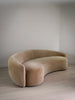
The Collection Seven mohair velvet palette includes oatmeal, smoke, dune, cocoa, carob and several other carefully calibrated tones. These are not generic upholstery choices — they are considered materials with a presence that rewards sustained attention. A Golborne Sofa in oatmeal mohair velvet, for instance, has a warmth and depth that shifts noticeably between morning and evening light — it is one of those pieces of furniture that looks genuinely different at different times of day.
How Velvet Behaves in a Room
Velvet absorbs light rather than reflecting it. In a room with strong directional light — from a south or west-facing window — velvet takes on extraordinary depth and richness in the afternoon and evening. In a north-facing room with diffuse, cool light, velvet can sometimes look slightly flat, though this depends significantly on the specific tone chosen and the other materials in the room.
The practical reality of velvet is that it marks. Sustained pressure — sitting in the same spot repeatedly, or cushions placed against the back — will flatten the pile in those areas over time. This is not a flaw unique to any particular manufacturer; it is an inherent property of pile fabrics. The good news is that it is largely reversible: lightly steaming the flattened area and brushing the pile in the direction of its grain will restore the surface in most cases.
Velvet is not the first choice for households with very young children or pets. It requires more active maintenance than a flat-weave fabric. But for those who value the material quality of their environment and are prepared to give a beautiful piece the attention it deserves, it offers a richness of surface that no other fabric quite replicates.
What Linen Actually Is
Linen is a natural fibre derived from the flax plant, and it has been used in domestic interiors for centuries. Its defining characteristic is an inherent irregularity — the slight variations in thread thickness and weave that give linen its textured, organic quality. This irregularity is not a quality-control issue; it is the fabric's character. It is precisely what distinguishes a linen-upholstered piece from one covered in a synthetic flat weave.
The Collection Seven linen palette is extensive, running from the palest chalk and cream through ivory, parchment, bamboo and truffle, and on to deeper tones like espresso, walnut and terra. There is also a cloud linen category — a softer, slightly more textured linen with a gentler handle than the standard range — in macadamia, cotton and canvas. Each tone reads differently under different light conditions, and the range has been curated to work coherently as a palette, meaning pieces in different linen tones from the collection will sit naturally together.
How Linen Behaves in a Room
Linen scatters and diffuses light rather than absorbing it. This gives linen-upholstered furniture a quality of openness and ease — it tends to make rooms feel larger and lighter, even in configurations where a velvet sofa of the same dimensions would feel more enclosing. For north-facing rooms, rooms with limited natural light, or rooms where the priority is to create a sense of airiness, linen is almost always the stronger choice.
Linen also has the quality of appearing to change over time in a way that is consistently beautiful rather than deteriorating. A linen sofa that has been lived in for several years develops a softness and ease that a new piece lacks — the fabric relaxes slightly, the tones mellow, and the piece acquires a kind of settled quality that is characteristic of natural fibres used well. This is one of the properties that makes linen a deeply rewarding long-term choice.
Practically, linen is more forgiving than velvet. It does not show pile marks. Most spills can be addressed promptly with a clean, damp cloth. And its natural texture means that minor surface variation — the kind of everyday wear that would be more visible on a smooth velvet — is absorbed into the fabric's existing character rather than reading as damage.
The Clarendon Sofa in chalk or cream linen demonstrates how linen can work on an architecturally clean silhouette. The fabric enhances the linearity of the design — the smooth, slightly matte surface reinforcing the precision of the form rather than competing with it.
The Room as the Deciding Factor
Once you understand what each fabric does, the room itself becomes the primary guide to your choice. Several factors are worth considering in sequence.
Light Conditions
As noted above, velvet performs best in rooms with warm, directional light — south or west-facing rooms where the afternoon and evening light has a richness that the pile can absorb and amplify. Linen performs consistently across all light conditions and is particularly strong in north-facing or east-facing rooms where the light is cooler and more diffuse.
Household Context
A household with young children or pets is better served by linen in most cases. The ability to spot-clean easily, the absence of pile that marks and requires maintenance, and the natural durability of linen make it a more practical choice for busy households. For a more considered, adult environment where the furniture will be used with some care, velvet — and particularly mohair velvet — is a deeply rewarding option.
The Rest of the Room
Consider the other materials already present in the room. A room with significant amounts of hard, reflective surfaces — polished timber floors, glass, stone — will be softened and warmed by a velvet sofa. A room that already has a lot of texture and material richness — layered rugs, natural textiles, timber — may be better served by the relative quietness of a linen sofa, which can sit within a complex material context without competing with it.
Mixing Velvet and Linen in the Same Room
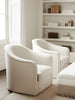
There is no rule that a room must commit entirely to one material. A linen sofa alongside a velvet lounge chair — or a velvet sofa with a linen ottoman — creates a layering of surface quality that enriches a scheme without complicating it. This is one of the particular advantages of working with a range designed around a coherent palette: Collection Seven fabrics are calibrated to sit together, meaning the ivory boucle, the chalk linen, the oatmeal mohair velvet and the ecru boucle all exist in productive relationship with one another.
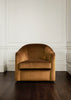
A Beaufort Sofa in parchment linen paired with a Talbot Chair in fallow velvet, for instance, creates a warm tonal arrangement where the two fabrics are related in tone but distinct in surface quality. The contrast between them is not jarring — it is the kind of considered material dialogue that gives a room depth without requiring colour.
The Importance of Swatches
Whatever conclusion you reach from reading this guide, the most important single step before ordering any upholstered piece is to assess the fabric in your own room. The way a fabric reads on screen — even a well-calibrated one, under controlled photographic lighting — is not the way it will read in the particular light conditions of your home, alongside your specific flooring, wall colour and existing textiles.
Fabric swatches are available from the Collection Seven store for £3 each. Ordering three or four candidate swatches and placing them in your room at different times of day — morning, midday, evening with lamps — will tell you more about the right choice than any amount of screen-based comparison. It is a small investment that consistently prevents larger, more expensive mistakes.
Once you have identified the right fabric, the rest of the process — choosing size, configuration and any bespoke requirements — can begin with confidence. Get in touch with the team to discuss your specific requirements, or explore the full sofa collection to identify the silhouette that suits your room.