collection seven, furniture guide, interior design
The Case for Subtle Statement Furniture
The Loudest Rooms Are Rarely the Most Interesting
The idea of a statement piece in interior design has become almost synonymous with conspicuousness — a dramatically oversized sofa, a colour so saturated it demands immediate attention, a form so unusual it becomes the sole subject of the room. These approaches can work. They have their place in certain contexts and certain hands. But they are not the only way to make a room feel considered and alive, and for most domestic interiors they are not the best way.
There is a subtler and, ultimately, more sophisticated kind of statement — one that makes itself through the quality of material, the precision of proportion and the integrity of design rather than through scale or spectacle. This kind of statement is made by furniture that rewards sustained attention; that reveals more the longer you live with it; that belongs to the room because it was chosen with genuine care rather than because it was impossible to overlook.
This is the territory that the best contemporary British furniture occupies, and it is the approach that produces the most enduring interior results.
What Makes a Piece Quietly Distinctive
A piece of furniture makes a subtle but genuine statement when it possesses qualities that reward sustained attention — when it continues to reveal itself over time rather than being immediately exhausted by a single look. These qualities tend to come from one or more of the following sources.
Exceptional Material
A material of genuine quality — mohair velvet with its characteristic lustre, boucle with its layered textural surface, burr veneer with its remarkable natural patterning — transforms any piece that carries it. The material becomes part of the design's identity, not just its covering. You do not have to announce a piece in oatmeal mohair velvet; it announces itself, quietly and continuously, through the way it responds to light throughout the day.
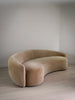
The Golborne Sofa in oatmeal or smoke mohair velvet is a strong example. The curved form of the sofa already has a distinctive presence; the mohair velvet adds a material richness that makes the piece read differently at different times of day and from different distances. This is the quality of a piece that remains interesting to live with over years — not because it is spectacular, but because it has depth.
A Distinctive Silhouette, Held With Restraint
A piece can have a clearly distinctive form without being theatrical. The distinction comes from the logic and quality of the design rather than from formal excess. A silhouette that is specific enough to be recognisable and memorable, but resolved enough to sit quietly within a broader arrangement, achieves the modern classic ideal of presence without imposition.
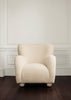
The Pembridge Chair is a good example. Its curved, enveloping form is immediately distinctive — there is nothing generic about its silhouette. But it does not shout. It sits in a room and invites attention rather than demanding it. In natural or putty faux shearling, the material quality reinforces the form's warmth and invitation, creating a piece that people are drawn toward without quite being able to articulate why.
A Detail That Reveals Itself on Closer Inspection
Some of the most enduring furniture designs contain details that are not immediately apparent at a viewing distance but reveal themselves as you approach and interact with the piece. These details — a precise piped edge, a considered fringe trim, a subtle change in grain direction on a veneer panel — are the marks of genuine craft and genuine design thought. They give the piece a quality of reward for close attention that mass-produced furniture, where the design process stops at visual effect from a distance, cannot replicate.
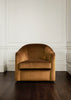
The piped detail on the Talbot Chair — running around the curved arms and back, precisely executed — is a good example of this kind of detail. From across a room, the chair reads as a considered, well-proportioned piece. Up close, the precision of the piping and the quality of the curved form reveal a level of craft that elevates the piece further. This is the quality that makes furniture worth investing in: it holds up to proximity.
Statement Through the Unexpected
One of the most effective ways to introduce a quiet but confident statement into a room is through an unexpected material choice on an otherwise restrained piece. A bench in a pattern fabric within an otherwise all-neutral scheme; a chair in faux shearling within a room built around linens and boucles; a bed with Poplar burr veneer posts within a bedroom of quiet upholstery and natural materials. In each case, the statement comes not from the design being conspicuous but from the choice being specific and considered — from the evidence that someone thought carefully about this room and made a deliberate, unusual decision.
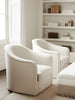
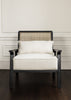
The Holland Chair with its rattan back detail is an example of this approach in the Collection Seven range. In a room built around velvet and linen, a Holland Chair in ecru boucle or canvas cloud linen introduces a structural, natural element — the rattan — that reads as considered contrast rather than decorative noise. It gives the room a note of character that a more conventional chair choice would not.
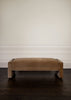
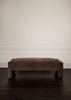
Similarly, a Blenheim Bench in the autumn tapestry pattern within a neutral living room introduces warmth and visual interest in a contained way — the pattern is on a single piece, the rest of the room is quiet, and the result is a room with a point of view rather than a room that is simply decorating.
The Artesian Bed: A Quietly Architectural Statement
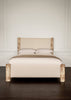
In the bedroom, the Artesian Bed with its four Poplar burr veneer posts makes a genuinely architectural statement without requiring anything else in the room to amplify it. The posts give the room a sense of vertical rhythm and occasion — an awareness that the bed is the most significant object in the space, and that this significance is worth acknowledging — but the design is controlled enough that the room is not overwhelmed. The burr veneer itself is extraordinary in its natural patterning: no two pieces are the same, and the organic complexity of the grain creates a surface that rewards close attention in the way that the best natural materials always do.
This is the definition of a subtle statement in furniture: a piece that changes the character of its room significantly and permanently, while remaining entirely at home within it.
Building a Room Around a Quiet Statement
When a piece of furniture is chosen to make a quiet but genuine statement, the room around it should be designed to give that piece the space it needs. This means restraint in the surrounding elements — quieter fabrics, simpler forms, a palette that supports rather than competes with the statement piece.
A sofa in oatmeal mohair velvet works best when the other upholstered pieces around it are in quieter, flatter materials — chalk linen, canvas cloud linen, ivory boucle. The velvet then has the material context it needs to be read clearly: the contrast between its luminous surface and the quieter materials around it is what makes the statement legible.
The same principle applies to any statement piece. A room that contains multiple statements contains none — the eye has nowhere to rest and the room feels over-decorated and anxious. One piece, chosen with genuine care and given appropriate surrounding quiet, creates the kind of interior that rewards living in over years rather than over minutes. Explore the full Collection Seven range to identify the piece that could anchor your room in this way.