collection seven, furniture guide, interior design
Ottoman vs Coffee Table: Which Is Right for Your Living Room?
The Most Used Surface in Your Living Room
Whatever sits in front of your sofa is one of the most used and most looked-at pieces in the living room. It occupies the centre of the seating zone — at eye level when seated, central to conversation, in constant relationship with the sofa, the chairs and the people who use the room. The choice between an ottoman and a coffee table is therefore not a peripheral one. It shapes the atmosphere of the room, affects how the space functions day to day, and contributes significantly to the material palette of the scheme.
Both options have genuine virtues and genuine limitations. The decision between them is not one of quality but of fit — which one suits your room, your habits and your priorities. This guide sets out to make that decision as informed as possible.
What a Coffee Table Offers
A coffee table provides a hard, stable surface. It is practical in the most direct sense: drinks, books, remote controls, candles and objects all have a firm, reliable place to sit. It is easy to clean. It defines the seating zone with clarity — its hard edges and fixed height create a permanent, unambiguous boundary to the arrangement.
The hard surface also has a visual directness that some rooms benefit from. In a scheme built around soft upholstery — a boucle sofa, velvet chairs, linen cushions — a coffee table in timber, stone or metal introduces a material contrast that grounds the arrangement and prevents it from feeling uniformly soft. This contrast can be very effective when handled well.
The limitations of a coffee table are equally real. It adds another hard material to a room that may already have several — timber floors, stone worktops, metal hardware — and in some schemes this accumulation of hard surfaces creates a room that feels cold or over-furnished. A hard-edged coffee table also has less flexibility than an ottoman: it cannot be used as additional seating when guests arrive, it cannot function as a footrest, and it does not add warmth or material richness to the room in the way that an upholstered piece can.
What an Ottoman Offers
An ottoman offers most of the same functional qualities as a coffee table — when topped with a tray, it provides a firm surface for drinks and objects — but introduces a further layer of upholstery into the room. This has both practical and aesthetic implications.
Practically, an ottoman is more flexible. It can function as a footrest in everyday use; as additional seating when you have more guests than chairs; as a surface for books and drinks when a tray is placed on top; and as a defining element of the seating zone in the same way a coffee table might. This flexibility is particularly valuable in living rooms that serve multiple purposes — rooms that function as both everyday sitting rooms and occasional entertainment spaces.
Aesthetically, an ottoman adds warmth and material richness. A room furnished with a sofa, chairs and an upholstered ottoman has a quality of material coherence — a sense that the room has been furnished as a whole — that a room with a hard-topped coffee table at its centre sometimes lacks. The upholstery creates a visual continuity between the pieces, tying the arrangement together in a way that a hard-topped table, however beautiful in itself, cannot quite replicate.
The Collection Seven Ottoman Range
The Collection Seven ottoman range spans several distinct designs, each suited to different contexts and aesthetic requirements.
The Ledbury Ottoman
The Ledbury Ottoman is the most straightforwardly functional piece in the range — firmly upholstered with a clean, contemporary form that reads as an architectural element within the seating arrangement. Its dimensions are generous enough to serve as a coffee table surface when topped with a tray, and its upholstery range — spanning velvets, linens and boucles — allows it to be calibrated precisely to the room's existing palette. In ivory boucle or macadamia cloud linen, it sits naturally within a neutral scheme; in chocolate velvet or seaweed velvet, it introduces a deeper, more grounding note at the centre of the arrangement.
The Bridstow Ottoman
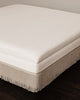
The Bridstow Ottoman takes a more decorative approach. Its fringe trim — available in pebble, snow, almond and bronze — adds a textural detail at the base of the piece that gives it a quality of considered ornament within the scheme. The fringe creates a visual transition between the upholstered body of the ottoman and the floor, softening what would otherwise be a hard edge. In ivory linen with a snow fringe, or in walnut linen with a bronze fringe, the Bridstow functions beautifully as a coffee table alternative while contributing something distinctly its own to the room.
The Bridstow is available in three sizes — small, medium and large — which allows it to be scaled to the specific proportions of the sofa and the seating zone. The medium size works well in front of a two or three-seater sofa; the large is better suited to a corner sofa or a more generous arrangement.
The Colville Ottoman
The Colville Ottoman is designed specifically as a companion to the Colville Chair, sharing its frame and fabric options. It functions primarily as a footrest within a dedicated chair arrangement — a reading corner, a window seat zone — rather than as the central piece of a sofa arrangement. In this role it is extremely effective: the consistency of frame and fabric between chair and ottoman creates a complete, self-sufficient seating arrangement that reads as designed rather than assembled.
The Elgin Footstool
The Elgin Footstool is the most characterful piece in the ottoman range — its two-tiered seat design and three spherical feet give it a quality of playfulness that the other pieces do not have. It works particularly well in secondary positions: beside an armchair, at a dressing table, or as one of two small footstools placed in front of a sofa rather than a single large ottoman. Two Elgin Footstools in complementary fabrics create a more dynamic arrangement at the centre of a seating zone than a single large piece.
The Sloane Ottoman
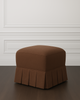
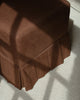
The Sloane Ottoman brings a more tailored quality to the range. Its box-pleat skirt and clean linen finish give it a smart, structured look that suits more formal living rooms or dining-adjacent spaces. Available in a range of linen tones from bamboo and chalk through to espresso and walnut, and in three sizes, it can be calibrated precisely to the room's palette and proportions.
Scale and Proportion: The Non-Negotiables
Whichever option you choose, proportion is the most critical factor. The ottoman or coffee table should span at least two thirds of the sofa's width. It should sit at approximately the same height as the sofa seat cushion — within 5cm either way. Too low and it feels disconnected from the sofa; too high and it interrupts the room's horizontal flow and creates practical awkwardness.
The gap between the sofa and the ottoman should be 35–45cm — close enough to be comfortably reached from the sofa, far enough to allow movement around the piece and give the arrangement breathing room.
Using a Tray to Bridge the Difference
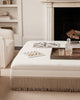
One of the most practical ways to make an ottoman function as a coffee table is to place a large, firm tray on its surface. A round or rectangular tray in timber, lacquer or natural material creates a stable hard surface for drinks and objects while preserving the warmth and flexibility of the upholstered piece beneath. This simple solution resolves the primary practical objection to the ottoman as a coffee table substitute — and it allows the tray itself to become a styling element within the arrangement, holding books, a candle and a small object in a considered grouping.
Making the Decision
If the priority is hard practicality and a defined, permanent surface: a well-chosen coffee table may genuinely be the right answer. If the priority is material warmth, flexibility of use, additional seating capacity and a sense of coherence within the upholstered scheme: an ottoman is almost always the more interesting and more rewarding choice.
For rooms that are heavily used — where the central piece will take significant wear, be climbed on by children or settled on by pets — an ottoman is more forgiving than a hard table. Its surface can be cleaned and maintained; the fabric itself, chosen well, will age with character. Explore the full ottoman collection here and order fabric swatches to assess the options in your room before committing.