collection seven, furniture guide, interior design
Modern Classic Interior Design: A Guide
An Approach, Not a Style
Modern classic interior design is one of those terms that is used frequently and defined rarely. It is not a style in the conventional sense — it has no signature colour palette, no defining period reference, no specific set of motifs or decorative elements that mark it out. It is, more accurately, an approach to the design and furnishing of interiors — one characterised by a commitment to quality, proportion and longevity over novelty and trend responsiveness.
Its defining quality is that it looks right without being dateable. A well-executed modern classic interior does not announce itself as belonging to a particular decade. It does not feel as though it is responding to a current moment in design culture. It simply works — coherently, beautifully, and durably — in a way that continues to work as the world around it changes. This is the most demanding standard in interior design, and it is the one that produces the most enduring results.
This guide examines what the modern classic approach actually means in practice — specifically in the context of furniture selection and room arrangement — and how to achieve it in a domestic interior.
The Three Principles
Modern classic interior design, understood as an approach rather than a style, can be organised around three core principles: proportion first, quality of material over quantity of objects, and coherence of palette. These principles are interrelated and mutually reinforcing — rooms that embody all three have a quality of completeness that rooms violating any one of them tend to lack.
Proportion First
In a modern classic interior, proportion takes precedence over every other consideration. Furniture is selected and placed with strict attention to its relationship with the room's architecture and with the other pieces in the arrangement. Scale is always considered: a piece must be large enough to read as intentional in the space it occupies, and small enough not to overwhelm the room or the arrangement around it.
This means that before any specific sofa or chair is chosen, the room is understood — its ceiling height, its window proportions, its architectural scale — and furniture is selected in response to that understanding. A tall, high-backed sofa in a room with low ceilings will create a sense of pressure and enclosure. A low, streamlined sofa in a room with generous ceiling height and large windows will feel undersized and tentative. Getting the proportion right is the condition for everything else working.
The Collection Seven range has been designed with proportional rigour as a central value. Pieces like the Beaufort Sofa and the Golborne Sofa have back heights and overall scales that relate naturally to the range of British living room proportions, which is why they work across a wider variety of contexts than more extreme or trend-specific designs.
Quality of Material Over Quantity of Objects
Modern classic interiors are characterised by restraint — not poverty, but the deliberate choice to include fewer objects of greater quality rather than more objects of lesser quality. The room breathes. Each piece has space to be read in its own right. The quality of the materials — the depth of a velvet, the texture of a linen, the grain of a timber floor — is given space to be perceived rather than being competed with by surrounding clutter.
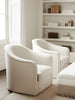
This principle has direct implications for furniture selection. Rather than filling a room with many pieces, the modern classic approach selects fewer pieces with greater care. A sofa, a chair, an ottoman and a bench — each chosen with precision for its specific role in the arrangement — will create a more successful room than a space filled with more pieces selected less carefully.
Material quality is equally important. The fabrics in a modern classic interior should have genuine material character — not the decorative quality that comes from pattern or strong colour, but the inherent quality of a well-made material: the lustre of mohair velvet, the organic variation of linen, the warmth of boucle. These qualities are perceived and appreciated over sustained contact with the room, which is exactly the kind of engagement a well-designed interior rewards.
Coherence of Palette
A modern classic interior has a coherent palette — one in which the various elements of the room exist in productive relationship with each other rather than in competition. This does not mean monochromatic. But it does mean that each material and colour choice is made with awareness of its relationship to the others, and that the overall effect is of a room whose elements have been chosen together rather than assembled independently.
The Collection Seven fabric palette is designed with this coherence explicitly in mind. The linens, boucles, velvets, mohair velvets and cloud linens have been calibrated to sit together — which means mixing fabrics across pieces produces coherent rather than competing results. A sofa in ivory boucle, a chair in fallow velvet, an ottoman in cream linen and a bench in oatmeal mohair velvet will create a palette that is tonally unified and materially rich, despite the variation in surface quality between the pieces.
Furniture That Embodies the Modern Classic Approach
Not all furniture is equally suited to the modern classic approach. Trend-led designs — pieces that respond to a specific moment in design culture — will date as that moment passes. Historicist designs — pieces that borrow explicitly from period vocabulary — can feel incongruous in rooms without the architectural context to support them. Modern classic furniture occupies the territory between these poles.
Its characteristics are: clear, considered proportions that reflect an understanding of how furniture works in rooms; quality of construction that is evident without being ostentatious; material choices that reinforce the form rather than decorating it; and a design language that is contemporary in expression without being trend-dependent in content.
The Golborne Sofa
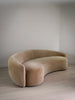
The Golborne Sofa exemplifies this approach in the Collection Seven range. Its sculptural, curved form has a clear and distinctive silhouette that is neither historicist nor fashionably minimal. It has genuine presence in a room — the kind that comes from the quality of the form rather than from applied decoration — and it reads as contemporary without being obviously of the moment. In oatmeal mohair velvet or ecru boucle, it is a piece that will belong as naturally in a room twenty years from now as it does today.
The Talbot Chair
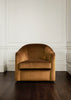
The Talbot Chair has a similar quality. The piped detail that runs around its curved arms and back is a design feature of genuine refinement — specific enough to give the piece its character, restrained enough not to date it. Its proportions are resolved: the relationship of back height to seat depth, arm height to seat height, overall width to depth — all of these are correct in the way that a furniture design arrived at through careful consideration rather than fashion intuition tends to be correct.
The Artesian Bed
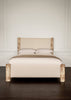
In the bedroom, the Artesian Bed makes a quietly architectural statement with its four Poplar burr veneer posts. The posts give the room a sense of vertical rhythm and occasion — an awareness that the bed is the most significant object in the space, and that it should announce this — without resorting to the theatrical excess of fully canopied four-poster designs. This is precisely the modern classic balance: presence without showmanship.
The Role of Craft
One of the distinguishing characteristics of modern classic interior design is that it tends to value craft — the evidence of skilled human making — over the anonymous precision of industrial production. This is not sentiment. Craft produces qualities in objects that industrial production cannot replicate: the subtle variation that makes handmade upholstery work more interesting to look at than machine-made equivalents; the precision that comes from a skilled maker attending carefully to a single piece rather than an operator monitoring a production line.
Collection Seven's commitment to handcrafting every piece in London is not incidental to the quality of the results. It is constitutive of it. The pieces that embody the modern classic approach — that have genuine presence, considered proportions and the quality that rewards sustained attention — are the pieces made with care by people who understand what they are making. Read more about the Collection Seven process here, and contact the team to discuss how the range might work within a specific interior project.