Interior Design
The Art of Mixing Old and New Furniture
There is a particular flatness to a room furnished entirely from one place at one moment, everything new, everything matched, everything of a single period. It can be handsome, but it rarely has the depth of a room assembled over time, where old and new sit together and talk to each other. The most compelling interiors almost always mix, the antique with the contemporary, the inherited with the newly bought.
Mixing is a skill, and like any skill it can be done well or badly. Badly, it is a jumble. Well, it is rich, layered and personal, a room with a story. Here is how to get it right.
Why it works
The appeal is the tension between old and new. An antique brings history, patina, a sense of continuity; a contemporary piece brings freshness, clean lines, a connection to now. Put them together and each sets the other off. The antique looks more characterful beside the contemporary, and the contemporary looks more grounded beside the antique.
A room of only antiques can feel like a museum. A room of only new pieces can feel like a showroom. The mix avoids both, and gives you a room that feels lived-in and evolved. It is the difference between a room that has been decorated and one that has been collected.
Find a common thread
The key to mixing well is a common thread that ties the disparate pieces together. Without one it reads as chaos. With one it reads as a considered collection. The thread can take a few forms.
A shared palette is the most reliable. If the old and new pieces, however different in period, share a tonal range, the eye reads them as belonging together. A contemporary sofa in a warm neutral can sit beautifully next to an antique timber cabinet or an inherited armchair if the tones relate. This is where furnishing the new pieces from a coherent palette really helps, a contemporary piece in a considered neutral is far easier to marry with older things than one in an assertive colour.
A shared material does the same job, a recurring timber tone, a consistent metal finish, a repeated texture. So does a shared sensibility, pieces of very different periods can relate through a common restraint, or craftsmanship, or elegance, even with no obvious visual feature in common.
Let the new pieces be quiet anchors
It usually works best to let the larger, newer pieces stay relatively quiet, a calm foundation the more characterful old pieces stand out against. A contemporary sofa in a restrained neutral becomes a quiet anchor that lets an antique side table, an inherited chair or a piece of vintage art be the character in the room.
A sofa like the Courtnell, with its refined proportions and clean lines, or the Clarendon, minimalist and calm, plays this role well. Its simplicity and quiet palette are the steady ground the older pieces layer against, so the antiques bring the personality while the new piece brings comfort and coherence.
Mix within categories, not just across the room
The most sophisticated mixing happens within categories, not only across a room. A set of dining chairs need not all match. A run of contemporary chairs with two antique carvers at the ends; a mix of related but not identical chairs around one table. That is what gives a dining room the collected quality all-matching sets lack.
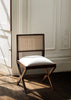
The Westbourne Dining Chair, with its Jeanneret-inspired design, rattan back and antique brass detail, sits particularly well in a mixed setting. Its own way of referencing a mid-century idiom gives it an affinity with both older and newer pieces, so it can bridge a mix of periods around a table with ease.
Give everything room to breathe
A mix of old and new needs space to read clearly. Crowd disparate pieces together and it becomes a jumble. Give each a bit of breathing room and the eye can appreciate both the individual pieces and the relationships between them.
This matters most when a piece is genuinely special, an antique of real character, something inherited with history. Those reward being given space, a clear spot where they can be seen, rather than lost in a crowded arrangement. Restraint in the number of pieces is often what lets a mix succeed.
Mixing with confidence
Mixing old and new is one of the most rewarding ways to furnish a home, giving you the depth, character and personal quality that all-new, all-matched schemes rarely reach. Find a common thread, let the newer pieces anchor the more characterful old ones, and give everything room to breathe. Done with a bit of confidence and restraint, you get a home that feels genuinely yours, layered with history and firmly of the present.
Have a look at the collection to find the contemporary pieces that will anchor your mix, and order swatches to choose tones that will marry with your existing and inherited pieces. Want to talk through how a new piece will sit alongside what you already have? Get in touch.