collection seven, furniture guide, interior design
Why Made-to-Order Furniture Is Worth It
Made for You, Not Made for Many
The phrase made to order appears on a great deal of furniture marketing, applied to products that are really just sold in options. True made-to-order furniture is something quite different: a piece that does not exist until it is made for you. There is no warehouse stock. No existing object awaiting dispatch. The piece is built from the beginning — to your confirmed dimensions, in your chosen material, by craftspeople working on your specific commission.
This distinction matters because it changes what is possible. The decision to work with a made-to-order maker rather than buying from stock is not merely an aesthetic preference. It has direct, practical consequences for the quality of the piece you receive, the degree to which it belongs to your specific room, and how it performs over the years and decades of its useful life.
This guide sets out the genuine benefits of the made-to-order approach — not as a marketing position, but as an honest account of what it actually changes in the piece you receive and the experience of commissioning it.
Benefit One: Dimensions That Actually Fit
The most immediately practical benefit of made-to-order furniture is the ability to specify dimensions for your actual room rather than adapting your room to accommodate a standard size.
UK living rooms vary enormously in scale and configuration. Victorian and Edwardian terraces have sitting rooms with alcoves, chimney breasts and irregular proportions that rarely accommodate standard furniture dimensions without some degree of compromise. Modern apartments have open-plan areas where the sofa must define a zone without the support of walls, requiring specific proportional decisions that a standard range of sizes may not address. Contemporary new builds have rooms that are compact by design, where a standard two-seater may be slightly too narrow and a three-seater clearly too wide.
In each of these situations, the ability to specify exact dimensions — the width that fills an alcove correctly, the depth that suits a particular seating arrangement, the configuration that works with a specific room plan — is not a luxury but a practical necessity for a genuinely well-furnished room. Furniture that fits a room precisely creates a quality of rightness that no amount of decoration can compensate for when it is absent.
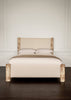
At Collection Seven, all pieces — from the Clarendon Sofa to the Artesian Bed and every piece in between — are made to order in London. Conversations about sizing, including non-standard dimensions, are part of the routine process rather than a special exception. Contact the team with your room dimensions to discuss what is possible.
Benefit Two: Material Choice That Is Genuinely Yours
When you buy furniture from stock, the material choices available to you are determined by what the manufacturer has decided to produce and hold. If none of those choices is quite right for your room — the wrong tone for your light conditions, the wrong texture for the palette you are building, not quite the right relationship with your existing materials — there is nothing to be done about it. You accept the best available option rather than the right one.
With made-to-order furniture, the material choice is genuinely yours, within a curated palette that has been assembled with quality and coherence in mind. The Collection Seven fabric range spans dozens of options across velvets, mohair velvets, linens, cloud linens, boucles, faux shearlings and patterns. The wood stain options for frames — bleached oak, white wash, walnut look and black — allow the structural elements of a piece to be calibrated to the room's existing timber finishes.
These choices are not cosmetic. The relationship between a piece of furniture and the room it lives in depends substantially on the material decisions made. A sofa in the wrong tone for the room's light conditions will always feel slightly off, even if its form is perfect and its construction is excellent. Getting the material right — through the made-to-order process, assessed through fabric swatches ordered and placed in the actual room — is what allows a piece to truly belong to its space.
Benefit Three: Construction Quality That Mass Production Cannot Match
Made-to-order furniture built by skilled craftspeople uses construction methods and levels of care that volume production cannot accommodate. The economics of mass manufacturing require efficiency above all — joints that are quick to execute rather than strongest; finishes that meet a minimum acceptable standard rather than expressing the maker's full capability; upholstery work that is consistent enough rather than precise.
In made-to-order production, the economics are different. Each piece is built once, for a specific commission, by makers whose skill and attention determine the quality of the result. This shows in the construction — in the precision of the upholstery work, the quality of the joinery, the consistency of the finish. And it shows in the long-term performance: a piece built well, to a maker's full standard, will maintain its quality over decades in a way that a piece built to production efficiency standards will not.
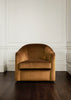
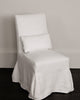
Every Collection Seven piece is handcrafted in London by makers working to this standard. The evidence is in the finished objects — in the precision of the piped details on the Talbot Chair, the quality of the pleating on the Aubrey Dining Chair, the consistency of the form on every sofa in the range.
Benefit Four: A Piece That Belongs to Your Home
There is a quality that well-chosen, well-made furniture that has been specified for a particular room possesses — a quality that is difficult to articulate but immediately apparent — of belonging. The piece fits. Not just physically, though that matters. It fits materially, tonally, proportionally. It was chosen for this room and it reads that way.
This quality of belonging is the cumulative result of the other benefits described above: dimensions that fit the space, materials chosen for the specific light conditions and palette, construction quality that maintains the piece's integrity over time. But it is also something more than the sum of these parts. It is the quality of a home that has been furnished with intention rather than assembled from available options.
A made-to-order piece in a room it was specified for occupies that room differently from a stock piece placed in a space it was not designed for. The former has a quality of inevitability — of being where it should be. The latter, however good in itself, tends to feel slightly placed rather than belonging.
The Trade Programme
For interior designers and architects working on client projects, the Collection Seven trade programme extends the made-to-order offer further. Bespoke sizing, customer's own material (COM), and accommodations for more complex or larger orders are all available within the trade framework. The programme is designed to integrate smoothly into professional project workflows while maintaining the quality standards that define every Collection Seven piece.
Trade applications are welcomed, and the team works directly with designers to ensure that the Collection Seven pieces specified for client projects are made to the highest possible standard for each specific context.
The Lead Time Question
The most frequently cited objection to made-to-order furniture is lead time. Buying from stock means receiving a piece within days or weeks. Commissioning a made-to-order piece means waiting — typically several weeks to a few months, depending on the piece, the specification, and the current production schedule.
This is a genuine difference, and it requires planning. But it is worth contextualising: a sofa that will be in your home for twenty or twenty-five years is worth waiting ten or twelve weeks for. The wait is not a cost — it is the time that the making requires. Rushing it would compromise the quality that makes the wait worthwhile in the first place. Most buyers, once the made-to-order piece arrives, find that the waiting time has already been forgotten.
Begin the process by browsing the full Collection Seven range and ordering fabric swatches to assess the materials in your room. Then contact the team to discuss dimensions, configuration and any specific requirements. The process is designed to be clear, collaborative and straightforward.