collection seven, furniture guide, interior design
How to Style a Neutral Sofa
The Neutral Sofa as an Invitation
A sofa in ivory boucle, chalk linen, oatmeal mohair velvet or any of the quieter tones in the neutral range is one of the most versatile foundations you can create in a living room. It does not impose a direction on the room; it does not restrict the palette of the things around it; it does not date in the way that a more committed colour choice might. It holds space without claiming it, and it adapts as the room evolves over years and seasons.
But a neutral sofa is not a finished room. Its versatility is precisely its invitation to add — to layer texture, to introduce tonal depth, to create the kind of considered, multi-dimensional atmosphere that distinguishes a well-furnished room from a merely equipped one. How you respond to that invitation determines whether the sofa becomes the foundation of a beautiful room or simply a large pale object occupying the floor.
This guide is about how to respond well.
Understanding What the Sofa Is Doing
Before adding anything to or around the sofa, it is worth understanding what the specific piece is already contributing to the room. A sofa in ecru boucle is already providing warmth and texture — what it needs around it is tonal depth and material contrast. A sofa in chalk linen is providing quiet, cool neutrality — what it needs is warmth and a sense of life. A sofa in oatmeal mohair velvet is providing luminosity and material richness — what it needs is restraint in the things around it, to give the fabric the space it deserves.
Styling a sofa well begins with accurately identifying what it already provides and working out what is genuinely missing — not adding things because they seem appropriate in a general way, but because they are specifically responsive to this particular piece in this particular room.
Cushions: The Foundation of Sofa Styling
Cushions are the most direct and most adjustable element of sofa styling. They are also the most frequently mishandled — either too many, too matchy, too patterned, or too generic. The principles that produce the best results are relatively simple.
Tone Over Pattern
In a neutral scheme, cushions are best used to introduce tonal variation and material contrast rather than pattern. A pattern cushion on a neutral sofa tends to read as decoration for its own sake — it adds colour and interest but also visual noise. A cushion in a fabric one or two tones deeper than the sofa, or in a material that contrasts with the sofa's surface quality, adds depth and interest that reads as considered rather than busy.
For a sofa in ivory boucle: cushions in sandcastle velvet, fallow velvet or oatmeal mohair velvet — all warmer and slightly deeper within the same neutral palette — create a tonal layering that gives the arrangement dimension. A linen cushion in bamboo or parchment adds material contrast (smooth linen against the textured boucle) while remaining tonally close.
For a sofa in chalk linen: cushions in ecru boucle, cream faux shearling or ivory linen introduce texture against the flat weave of the linen. A single cushion in a deeper tone — walnut linen or sepia velvet — can anchor the palette and prevent it from feeling too light.
Odd Numbers and Asymmetry
Odd numbers of cushions read more naturally than even ones. Three cushions arranged with deliberate asymmetry — two at one end of the sofa, one at the other — feels inhabited rather than staged. Five cushions, similarly arranged with an awareness of balance rather than perfect symmetry, create a generous, lived-in quality.
A single large cushion placed centrally or slightly off-centre can work well on a two-seater sofa with a clean silhouette — it reinforces the sofa's simplicity rather than adding clutter. On a three-seater, three cushions of different sizes in related fabrics creates a more dynamic arrangement.
Varying the Fabric
A set of cushions that all use the same fabric and are differentiated only by size is less interesting than cushions in two or three different materials. On a boucle sofa, the combination of a velvet cushion, a linen cushion and a second boucle cushion in a different tone creates a layering of surfaces that enriches the arrangement visually and tactilely.
Throws: Ease Without Decoration
A throw placed over one arm of the sofa, or folded across one end of the seat, adds a further material layer and a quality of ease — as if the room is genuinely lived in rather than arranged for a photograph. This quality is difficult to achieve through deliberate decoration and remarkably easy to achieve through a single well-chosen throw.
The throw should contrast materially with the sofa fabric. A fine wool or cashmere throw on a velvet sofa; a chunky knit on a linen sofa; a linen throw on a boucle sofa. The contrast in material creates visual interest; the similarity in tone keeps the scheme coherent.
Placement matters. A throw draped naturally over one arm, slightly trailing, reads very differently from a throw folded into a neat rectangle and placed symmetrically. The former suggests habitation; the latter suggests display. For a neutral sofa that is meant to feel lived-in and real, the former is almost always more effective.
The Chair as Counterpoint
Of all the things that can be placed in relation to a neutral sofa, a well-chosen lounge chair is the most transformative. A chair placed at a slight angle to the sofa — facing it rather than running parallel — creates a conversation arrangement that makes the room feel designed rather than default. It breaks the formality of sofa-only seating, adds a second silhouette into the scheme, and gives people a genuine choice about where to sit.
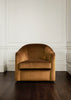
The Talbot Chair in fallow velvet or sandcastle velvet alongside an ivory boucle sofa creates the kind of tonal depth that a neutral room needs to feel rich rather than pale. The deeper, lustre-rich quality of the velvet contrasts with the matte, textured boucle, and the slightly warmer tone of the chair gives the arrangement a ground that the sofa alone cannot provide.
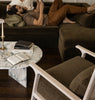
The Pembridge Chair in natural or putty faux shearling creates a different kind of accent — warmer, softer, more obviously inviting. Its deep pile contrasts strongly with any flat-weave or close-pile sofa fabric. In a room built around chalk linen or ivory boucle, a Pembridge Chair in faux shearling introduces a note of material luxury that elevates the whole scheme.
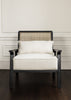
The Holland Chair, with its distinctive rattan back detail, can introduce a more eclectic note — the natural material of the rattan creates a connection to organic textures and a slightly more layered, less minimal aesthetic. In a neutral room that wants some character without committing to pattern or colour, the Holland Chair's structural interest makes it a compelling choice.
The Ottoman: Completing the Zone
An ottoman placed in front of the sofa completes the seating arrangement and defines the zone. It provides a surface — for books, a tray of drinks, a plant — and a visual anchor at the centre of the arrangement. In a neutral room, it is also an opportunity to introduce a further material layer.
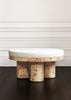
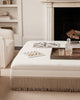
The Ledbury Ottoman in terra linen or espresso linen, placed in front of an ivory boucle sofa, creates a tonal relationship that moves from light at the sofa to slightly deeper at the centre of the arrangement — a grounding effect that gives the seating zone a sense of completeness. The Bridstow Ottoman, with its fringe trim, adds a decorative note that is appropriate in schemes where a degree of ornamental quality is wanted within the neutral framework.
Light as the Final Element
The quality of light in the room — and specifically the artificial lighting used in the evening — is the final and perhaps least appreciated element of sofa styling. A table lamp placed on a side table beside the sofa, or a floor lamp positioned near the arrangement, creates pools of warm light that make neutral fabrics appear richer, deeper and more alive. This is particularly true of velvet and mohair velvet: a sofa in oatmeal mohair velvet under directional lamp light is a very different thing from the same piece under flat overhead lighting.
Positioning a lamp at arm-height beside the sofa — rather than relying on ceiling lights alone — will transform how the arrangement reads in the evening, and will make the investment in quality upholstery fully visible in the way it deserves to be. Explore the full Collection Seven range for pieces that work together as a coherent scheme, and order swatches to assess materials in your specific room before committing.