collection seven, furniture guide, interior design
How to Choose the Right Sofa Size for Your Home in the UK
Why Sofa Size Is the Most Important Decision You Will Make
There is very little more disappointing in interior design than a sofa that does not fit. Not physically — though that happens too — but proportionally. A sofa that is too large crowds a room and makes movement feel awkward. One that is too small looks like an afterthought, floating in a space that needed something more substantial. Getting the size right is the first and most important decision in choosing a new sofa, and it deserves far more consideration than most people give it.
In UK homes especially — where living rooms vary enormously in scale, from generous double-reception rooms in Victorian terraces to compact open-plan spaces in modern apartments — the question of sofa size is rarely straightforward. There is no universal answer. But there is a logical process that, if followed carefully, will lead you to the right choice for your specific room.
Start With the Room, Not the Sofa
The single most common mistake people make when buying a sofa is falling in love with a design before they have properly measured their room. The room must come first. Before you look at a single piece of furniture, take the time to understand the space you are working with.
Measure the total floor area and note the position of every architectural feature: doors, windows, radiators, alcoves, chimney breasts. Note the routes people naturally take through the room — from the door to the television, from the sofa to the kitchen. A sofa should never obstruct natural movement. It should anchor the room without interrupting the flow of life through it.
Draw the room to scale on paper or using a simple floor planning tool. Place a scaled rectangle representing your intended sofa into the plan and see how it sits. This exercise, which takes no more than twenty minutes, will tell you more than any amount of showroom browsing.
The 60cm Clearance Rule
As a general principle, leave at least 60cm of clear passage around your sofa on all sides where people need to move. This allows comfortable circulation and prevents the room from feeling blocked or congested. In narrower rooms, this constraint may mean that a three-seater sofa is simply not viable — and that a two-seater or 2.5 seater paired with a well-chosen lounge chair is the more considered solution.
Pulling Away From the Wall
A common instinct is to push the sofa hard against the wall to maximise floor space. In practice, this rarely achieves the intended effect and often makes a room feel smaller rather than larger. A sofa sitting 15–20cm from the wall allows the space to breathe and gives the furniture a quality of intention — it looks placed rather than stored. It also allows a slim console table or a floor lamp to sit behind it, which adds depth and warmth to the scheme.
Understanding Sofa Dimensions
When you begin reviewing specific sofas, there are three measurements that matter most: width, depth and seat height. Each affects both how the sofa functions in the room and how comfortable it is to live with day to day.
Width
Sofa width is the measurement most people focus on, and rightly so — it is the dimension that most directly determines whether a sofa fits a room. In general terms, a two-seater sofa sits between 150 and 175cm wide; a 2.5 seater between 175 and 195cm; and a three-seater between 190 and 230cm. These are ranges rather than fixed rules, and the variation within them is significant.
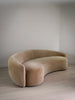
One of the most underappreciated advantages of made-to-order furniture is the ability to specify width precisely. At Collection Seven, every sofa is made to order in London, which means the width can be calibrated to your room rather than your room being adapted to accommodate a standard size. The Clarendon Sofa, for example, is available as a 2, 2.5 or 3 seater, and each configuration can be discussed in terms of exact dimensions to suit a particular space. The same applies to the Golborne Sofa, the Beaufort Sofa, and every other sofa in the collection.
Depth
Seat depth — the measurement from the front of the seat cushion to the back of the sofa — is the dimension that most affects comfort, and it is the one most frequently overlooked. A shallower seat of around 80–85cm total depth suits more formal sitting and compact spaces. A deeper seat of 90cm or more encourages a more relaxed, settled posture and is better suited to lounging and longer periods of use.
Consider who will use the sofa most and how. A deep sofa is luxurious for someone tall who likes to stretch out; the same sofa may feel awkward for someone shorter who prefers to sit upright. When possible, sit in a sofa before ordering — depth is one of those qualities that reveals itself immediately on contact but is almost impossible to assess from a specification sheet alone.
Seat Height
Standard seat height in UK upholstered furniture sits between 42 and 48cm from the floor. Lower seats — at the 42–44cm end — create a more contemporary, lounge-like aesthetic and a relaxed posture. Higher seats — 46–48cm — are easier to get in and out of and create a slightly more traditional, upright posture. If the sofa will be used primarily by older occupants or those with mobility considerations, the higher end of this range is worth specifying.
Two-Seater vs Three-Seater: A More Nuanced Question Than It Appears
In many UK living rooms, the three-seater is reached for instinctively — more seats means more value, the reasoning goes. But this logic does not always hold. A three-seater sofa in a room that would suit a two-seater will dominate the space, making everything else feel cramped and the arrangement feel forced.
A two-seater or 2.5 seater sofa paired with a well-chosen lounge chair creates an arrangement that is often more functional, more versatile and more visually interesting than a single large sofa. The chair can be positioned at a slight angle to the sofa, creating a natural conversation arrangement. It can be moved. It can be reupholstered independently. It introduces a second material and silhouette into the room, adding richness that a sofa alone cannot provide.
The Courtnell Sofa in a two-seater configuration, paired with a Talbot Chair or Pembridge Chair, is a combination that works extremely well in compact to mid-sized living rooms. The sofa provides the primary seating; the chair provides both additional seating and a focal point within the arrangement.
Corner Sofas: When They Work and When They Do Not
A corner sofa — or L-shaped sofa — is one of the most efficient uses of floor space in a living room, particularly in open-plan homes where the seating zone needs to be clearly defined within a larger area. The L-shape creates three natural edges to the zone, contains the space effectively, and provides generous seating in a relatively contained footprint.
However, corner sofas only work when the room genuinely suits them. They require a corner to anchor to — or a sufficiently large open floor plan in which they can float convincingly. In a small, square room, a corner sofa often feels claustrophobic, filling the space so completely that the room loses any sense of breathing room.
The Courtnell Corner Sofa is available in 3-seater and 4-seater configurations with both right and left chaise options, which allows the orientation to be specified for your particular room layout. In bamboo linen or a rich mohair velvet, it creates a generously proportioned seating zone that anchors an open-plan space without overcrowding it.
The Ottoman in Relation to the Sofa
Once the sofa size is established, the question of what to place in front of it becomes significant. An ottoman placed in front of the sofa defines the seating zone, provides a surface for books and drinks when topped with a tray, and adds a further layer of upholstery to the arrangement. The proportion of the ottoman relative to the sofa matters considerably: it should span at least two thirds of the sofa's width, and its height should sit within 5cm of the sofa seat height.
The Ledbury Ottoman, available in a range of velvets and linens, works well in front of most two and three-seater sofas. For larger arrangements, the Bridstow Ottoman — with its fringe detail and quietly decorative quality — makes a stronger visual statement.
Fabric and Colour in Relation to Room Size
The fabric you choose for your sofa affects how it reads in a room almost as much as its dimensions. Lighter fabrics — ivory boucle, chalk linen, cream linen — make a sofa feel lighter and less claiming of space. They reflect light and help a room feel open. Darker fabrics — espresso linen, sepia velvet, carob velvet — create a sense of weight and grounding that can be very beautiful in the right context but will make a room feel more enclosed.
In a smaller living room, the instinct toward a paler fabric is generally a sound one. In a larger room, a richer, deeper fabric can add the warmth and anchoring quality that an oversized space sometimes lacks. In either case, always order fabric swatches before committing to a choice — the way a fabric reads on screen is never quite the way it reads in your home.
Made to Order as the Solution to the Size Problem
For rooms with unusual dimensions — an alcove that is 182cm wide, a room that suits a 2.5 seater but nothing standard quite fills the space correctly — made-to-order furniture is the most elegant solution. Rather than adapting the room to the furniture, the furniture is made for the room. This is the founding principle of Collection Seven's approach.
Every sofa in the collection is made to order in London. This means that conversations about sizing are not an exception — they are part of the process. Get in touch with the team to discuss the specific dimensions of your room and which configuration would work best. Bringing in a floor plan, even a rough one, makes these conversations significantly more productive.
The investment in getting the size right at the outset — rather than compromising on a standard dimension and living with the consequences — is one that pays back every day for the life of the piece.