Furniture Guide
Bar Stools: How to Choose the Right Height and Style
Bar stools get chosen as an afterthought more than almost any other piece. People spend weeks agonising over a sofa, then grab the nearest cheap stool at roughly the right height. Which is odd, because the kitchen island is where everyone actually ends up, working, eating, talking, and you sit on those stools every single day.
A well-chosen bar stool does a lot of work. It is comfortable enough to linger on, it is the right height for the counter, and it adds character to one of the most-used spots in the house. Here is how to get all three right.
Get the height right first
Height is where people go wrong, and it is worth sorting before anything else, because a beautiful stool at the wrong height is annoying to use every day.
The rule is simple: you want a comfortable gap between the seat and the underside of the counter, around 25 to 30cm. Enough to cross your legs and get on and off easily.
Most UK kitchen counters sit around 90cm high, which wants a stool with a seat height of about 60 to 65cm. Taller bar-height counters, closer to 105 to 110cm, need a taller stool, around 75 to 80cm. Measure your counter from the floor to the top before you do anything else. If it is a non-standard height, this matters even more.
Comfort is not optional
Because you sit on them for long stretches, comfort matters far more than the small size suggests. A hard stool is fine for a minute and tiring over a working morning or a long evening. An upholstered stool with a proper seat changes how you use the whole space.
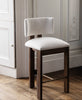
The Dawson Bar Stool is designed exactly for this. It is genuinely as comfortable as any of the lounge chairs in the collection, which means you settle onto it rather than perch. Whether you are working from the island or having a drink with friends, you do not need to get up and move somewhere comfier, which is rather the point of a well-furnished island.
Think about the back
Stools come with and without backs, and it affects both comfort and look. No back is more compact, tucks away neatly and gives you a cleaner, more minimal line. A back gives you more support for longer sitting and more presence as a piece.
The Dawson has a considered back detail that adds support and gives it real character. That back feature means the stool contributes something even from behind, which matters in an open-plan kitchen where you often see the stools from the living side rather than the kitchen side.
Fabric that can handle a kitchen
Stools live in a slightly tougher spot than furniture elsewhere, closer to cooking, more exposed to spills, in a high-traffic zone. So fabric is worth real thought.
For an island in daily use, go practical. A stain-resistant velvet or a durable linen copes with kitchen life far better than something delicate. The Dawson comes in the full fabric range, so you can pick something that handles the demands of the space while still getting the tone and character you want.
The frame stain, bleached oak, white wash, walnut look or black, should relate to the other timber in the kitchen, whether that is the flooring, the cabinetry or the island. Pick a stain that harmonises and the stools read as part of the room rather than an add-on.
How many, and how far apart
Allow around 60cm of counter per stool for comfortable elbow room. Cram too many along and everyone is squashed; space them properly and the island feels more considered and nicer to use. An odd number, three rather than four, often looks more relaxed, though it depends on the length of the counter and the size of the household.
Choosing yours
A stool that is the right height, genuinely comfortable, well made and in a fabric that suits the setting transforms how the kitchen island feels day to day. Given how much you use them, it is worth the thought.
Have a look at the bar stools, measure your counter carefully first, and order swatches to see the options in your kitchen light. Any specific requirement, just get in touch.