collection seven, furniture guide, interior design
Curved vs Straight Sofa: Which Is Right for Your Room?
Shape Is the First Design Decision
Before a fabric is chosen or a size determined, the shape of a sofa establishes the visual tone of a room. Curved forms and straight forms communicate different things — they create different kinds of atmosphere, suit different architectural contexts, and relate differently to the people and other objects around them. Understanding what each silhouette type actually does to a room is the foundation of a good sofa choice.
This is not simply an aesthetic question. The shape of a sofa affects how people gather around it, how it reads from different viewpoints, how it relates to the room's architecture, and how easily it accommodates a range of situations — from formal entertaining to relaxed everyday use. Getting the shape right is, in many ways, the most fundamental decision in the entire process.
What Curved Sofas Do
Curved sofas carry an inherent quality of softness and invitation. Their form turns slightly inward — gathering rather than presenting — which creates a natural sense of enclosure and intimacy. This is not accidental. The curved sofa has a long history in domestic interiors precisely because its form encourages people to gather, to face each other, to settle into a shared space rather than sit in parallel rows facing the same wall.
Historically, the relationship between curved seating forms and social gathering is direct and well-documented. The conversation sofa of the nineteenth century — a circular or S-shaped form designed explicitly for face-to-face conversation — was engineered around the social function of its shape. Contemporary curved sofas draw on this same understanding, even when they are far more restrained in their formal expression.
Curved Sofas in Contemporary Rooms
In a contemporary interior — particularly an open-plan room where the seating zone needs to be defined within a larger space — a curved sofa is a particularly effective choice. Its distinctive silhouette creates a visual boundary to the zone more naturally and more dynamically than a straight-armed piece. Seen from the kitchen end of an open-plan room, a curved sofa presents an interesting form rather than simply a rectangular back; it has a three-dimensional quality that straight sofas, viewed from behind, tend to lack.
The curved sofa also manages corner placement well. A piece with a gently curved back has a more natural relationship to the space behind it than a straight-backed piece — it seems to exist within the room rather than being pushed against its edges.
The Golborne Sofa
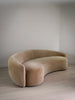
The Golborne Sofa is the most definitively curved piece in the Collection Seven range. Its sweeping, continuous back and gently bowed front create a sculptural silhouette that is immediately recognisable and unmistakably present in a room. This is not an aggressive or theatrical design — its curvature is controlled and its proportions are carefully resolved — but it has a presence that a straight-backed piece of the same dimensions does not.
In ecru boucle or oatmeal mohair velvet, the Golborne creates one of the strongest expressions of the modern classic curved sofa available in contemporary British furniture. In a two or three seater configuration, it works equally well as the anchor of a formal sitting room arrangement or as the defining zone piece in an open-plan living space.
The Beaufort Sofa
The Beaufort Sofa has a softer curve — its continuous back flows gently into sculpted arms rather than making the bold statement of the Golborne. This makes it a more versatile piece in terms of the contexts it suits: it has enough formal clarity to work in a traditional room, and enough restraint to sit comfortably in a contemporary one. The subtle curve of its form gives it a quality of settled ease that purely rectilinear pieces sometimes lack.
What Straight Sofas Do
Straight-armed, architecturally clean sofas offer a different kind of authority. They are more disciplined in form, more obviously in dialogue with the geometry of the room and its architecture. They suit formal or symmetrical arrangements particularly well — placed centrally facing a fireplace, flanked by matching chairs, in a room with strong linear features — because their rectilinear quality aligns naturally with the grid of the architecture.
A straight sofa is in many ways easier to work with in a traditional British living room. It does not impose a strong design statement on the space; it participates in the room's composition without demanding to lead it. This is not a criticism — the ability to sit quietly within a well-composed room while contributing to it is a genuine virtue in furniture design.
The Clarendon Sofa
The Clarendon Sofa is the cleanest expression of the rectilinear approach in the Collection Seven range. Its defining quality is the continuous arm and back design — an uninterrupted line that runs from the front of one arm, around the back, and down to the front of the other arm. This creates a sofa of great visual clarity: the eye travels the form without interruption, reading a single coherent gesture rather than multiple resolved parts.
In a room with strong architectural linearity — beamed ceilings, panelled walls, large rectangular windows — the Clarendon sits with exceptional naturalness. It participates in the room's geometry rather than contrasting with it.
The Courtnell Sofa
The Courtnell Sofa is similarly restrained, with its edited profile and generous single seat cushion creating a clean, contemporary silhouette. Its restraint makes it one of the most flexible sofas in the range — it suits both modern and period interiors without obviously belonging to either, which is precisely what allows it to endure as a design across changing contexts.
Corner Sofas: Curved or Straight?
The corner sofa — or L-shaped configuration — presents its own set of considerations that overlap with, but are not identical to, the curved versus straight question.
A straight-armed L-shape, like the Courtnell Corner Sofa, suits rooms with a strong rectilinear plan. Its clean angles align naturally with the room's geometry. In an open-plan space, it creates a defined zone with clear edges — visually and functionally delineating the seating area from the surrounding space. Available in 3 and 4 seater configurations with both right and left chaise options, it can be oriented to suit virtually any room layout.
A curved corner sofa creates a softer, more organic arrangement — the L-shape becomes less angular, and the overall effect is of a gathered, inward-facing zone rather than a rectilinear box. This can be very effective in rooms where the architecture already has strong geometry and where some relief from that angularity is wanted.
Mixing Curved and Straight in the Same Arrangement
There is no design rule that prevents curved and straight pieces from coexisting in the same seating arrangement — and in practice, the most interesting arrangements often exploit this contrast deliberately. A curved sofa paired with a straight-armed lounge chair creates a formal dialogue between the two forms; each is thrown into sharper relief by its contrast with the other.
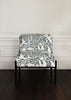
A Golborne Sofa paired with a Colville Chair — whose streamlined, straight-edged design is at the more rectilinear end of the chair range — creates exactly this kind of productive contrast. The organic curve of the sofa and the crisp linearity of the chair sit in conversation without competing, each making the other more legible.
The Room Shape as a Guide
When in genuine doubt about whether to choose a curved or straight sofa, the shape of the room itself is a useful guide. A strongly rectilinear room — long and narrow, with a regular plan and few irregular features — can benefit from the relief of a curved sofa. A room with irregular walls, alcoves, bay windows or unusual angles is often better served by a cleaner, straighter silhouette that does not add formal complexity to an already complex space.
The room, in other words, tends to tell you what it needs if you look at it carefully. The Collection Seven team is available to discuss specific room situations and to help identify which silhouette would work best in your particular context. Bringing a floor plan, even a rough sketch, makes these conversations significantly more productive. Browse the full sofa range to compare silhouettes side by side.