collection seven, furniture guide, interior design
Classic vs Modern Sofa Design: How to Choose
A Question Worth Taking Seriously
The distinction between classic and modern sofa design is one of the most frequently discussed and least carefully considered questions in furniture buying. It is often treated as a matter of personal taste — a choice between two equally valid aesthetic preferences with no underlying logic. But there is logic here, and it is worth understanding. The form a sofa takes, the vocabulary it draws on, and the design intelligence it embodies all have direct consequences for how well it functions in a room and how well it endures over time.
More importantly, the binary of classic versus modern is itself misleading. The most interesting and most enduring sofa designs occupy a position between these poles — drawing on traditional proportional thinking and construction approaches while expressing themselves in a contemporary idiom. This middle territory is where the best modern British furniture tends to sit, and it is worth examining carefully.
What Classic Sofa Design Actually Means
A classic sofa design is one that draws explicitly on historical forms and vocabularies. The rolled arm — a curving, padded arm that returns over itself — is one of the defining elements of the classic English sofa, with roots in the Georgian and Victorian periods. Button-back upholstery, shaped aprons, cabriole legs, scrolled detailing: these are the formal vocabulary of the classical British sofa, derived from a tradition that reached its most elaborate expression in the nineteenth century.
Classic sofa designs have real virtues. They are deeply considered forms, evolved over centuries to provide comfortable seating with a formal beauty appropriate to the most important room in the house. In the right architectural context — a Georgian townhouse, a Victorian drawing room, a country house interior with high ceilings, substantial cornices and period detailing — a classically proportioned sofa is genuinely the right choice. It honours the architecture and creates a sense of rightness that a more contemporary piece might not achieve.
The risk of classical sofa design is pastiche — pieces that borrow the historical vocabulary without the underlying design intelligence, producing objects that feel heavy, dated and overly formal in rooms that do not have the architectural gravitas to support them. In a modern apartment or a contemporary new build, a heavily rolled, button-backed Chesterfield-style sofa will almost always feel incongruous — not because classical design is wrong, but because it is being applied in a context it was not designed for.
What Modern Sofa Design Actually Means
Modern sofa design, in its most rigorous form, is characterised by a clarity and economy of means. Arms are straight or gently curved rather than rolled or padded. Backs are lower. Cushion arrangements are minimal — one or two pieces rather than many. The silhouette is clean and the form is resolved with as few elements as possible. The aesthetic prioritises restraint and precision over ornament and elaboration.
This approach is not simply a stylistic preference — it reflects a genuine design philosophy that values the inherent qualities of materials and form over applied decoration. A well-designed modern sofa is beautiful because its proportions are correct and its construction is honest, not because it has been dressed with detail.
The Clarendon Sofa exemplifies this approach within the Collection Seven range. Its continuous arm and back design creates a single, uninterrupted line from one side to the other. The singular seat cushion maintains this clarity. There is no applied decoration, no historical reference, no period detail — and yet it is unmistakably a considered and beautiful piece of furniture. Its quality is a function of its proportions and its material honesty, not of ornamental elaboration.
The Modern Classic: The Most Interesting Territory
Between the poles of historically derived classicism and strict contemporary minimalism lies the territory that produces the most enduring and most versatile furniture. The modern classic is characterised by design intelligence that draws on traditional proportional thinking — the knowledge of how furniture has worked well for centuries — without reproducing historical forms. It has the permanence and the considered authority of classical design without its period associations. It has the clarity and restraint of modern design without its potential coldness.
The defining quality of a modern classic piece is that it looks right without being dateable. It does not announce itself as belonging to a particular decade or responding to a particular trend. It simply works — in the room, at the scale, with the materials — in a way that continues to work as the surrounding context evolves.
The Golborne Sofa
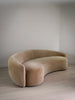
The Golborne Sofa is a strong example of modern classic design. Its sculptural, curved form has a clear silhouette that is neither historicist nor fashionably minimal. The continuous, sweeping back and bowed front create a distinctive presence in a room — a presence that comes from the quality of the form rather than from applied decoration. In ecru boucle or oatmeal mohair velvet, it is a piece that belongs equally in a period conversion and a contemporary apartment.
The Beaufort Sofa
The Beaufort Sofa takes a more quietly architectural approach. Its gently sweeping back flows into sculpted arms with a sense of organic continuity that owes something to mid-century precedents without being derivative of them. The proportions are considered, the form is resolved, and the result is a piece that sits with equal confidence in different decorative contexts.
The Albion Sofa
The Albion Sofa has the most classical inflection of the three — its gently curved arms and easy, settled form have a traditionally British quality that works particularly well in period interiors. But its proportions are contemporary rather than historicist: there is nothing pastiche about it. It is a modern piece that is at ease with its inheritance.
Matching Sofa Design to Architectural Context
The most practically useful consideration in choosing between classic and modern sofa design is not personal taste but architectural context. Different rooms create different expectations and provide different supports.
Period Rooms
Rooms with strong period architectural character — original cornices, sash windows, fireplaces with classical surrounds, high ceilings — generally support more formally proportioned furniture. A sofa with some classical reference will work naturally in this context; a very starkly minimal piece may feel at odds with the architecture. Modern classic designs that have quality and presence without explicit historical pastiche tend to work best across the widest range of period contexts.
Contemporary Rooms
Rooms with contemporary architecture — open plans, large glazed openings, minimal architectural detail, low ceilings — generally suit cleaner, more restrained silhouettes. The furniture needs to do less work here because the architecture is doing less — the room provides a neutral backdrop against which the furniture reads more directly. A clean, modern classic sofa in a considered fabric will be more effective than a heavily detailed classical piece.
Using Contrast Deliberately
Considered contrast — a very clean, contemporary sofa in a period room, or a piece with some classical quality in a stripped-back modern space — can be extraordinarily effective. The contrast makes both the furniture and the architecture more legible; each is thrown into relief by the other. The key is that the contrast is deliberate and controlled, not accidental.
The Question of Longevity
Perhaps the most important consideration in the classic versus modern question is longevity of design — how well the sofa will continue to feel appropriate over the years and decades of its useful life. Trend-led furniture dates quickly and becomes expensive over time (in terms of the frequency of replacement). A sofa designed with proportional intelligence and material quality rather than seasonal fashion remains appropriate across a much longer arc.
This is one of the core principles behind Collection Seven's design approach. Every piece in the range is designed to endure — to remain the right choice in five years, ten years, twenty years. The focus on proportion, material quality and construction integrity over trend-responsiveness is precisely what makes these pieces worthy of the investment they represent. Browse the full sofa range here and consider which silhouette would remain right for your room over the long term.