collection seven, furniture guide, interior design
How to Choose Dining Chairs
Dining Chairs Are Used More Than Almost Anything Else You Own
It is easy to underestimate the importance of dining chairs. They are not the largest piece of furniture in the room; they are not the most visually dominant. But in terms of daily use, they are among the most frequently occupied pieces in the home. A household that eats together once a day, that uses the dining table as a workspace and a social hub, may sit in dining chairs for two or three hours every day. Over the years, this accumulates into a significant portion of a lifetime spent in these particular seats.
This makes the quality, comfort and character of dining chairs a more consequential consideration than their relative visual modesty might suggest. Getting them right — in terms of proportion, comfort, material and relationship to the table and the room — produces a daily improvement in the experience of one of the most important spaces in the home. Getting them wrong produces a daily compromise that is noticed, if not consciously, every single day.
Proportion: The First Consideration
The relationship between the chair and the table is the primary proportional consideration in any dining arrangement. Specifically, the gap between the seat surface and the underside of the table should be approximately 25–30cm. This allows the seated person to be close enough to the table to eat and work comfortably, without the table bearing down on their thighs or the chair being so low that the table feels unnaturally elevated.
Most standard dining tables sit at around 75cm from the floor. This means a chair seat height of 45–50cm — allowing 25–30cm of clearance — will work correctly. Chairs outside this range are not unusable, but they will feel awkward with a standard-height table and should be selected with caution unless the table height is also non-standard.
The back height of the chair is a secondary proportional consideration. In rooms with high ceilings and generous proportions, a taller chair back can add presence and formality. In lower-ceilinged rooms, a more modest back height prevents the furniture from competing with the architecture.
Comfort Over Extended Sitting
Dining chairs are frequently evaluated at the point of purchase — sat in briefly in a showroom or on the basis of a specification sheet — without adequate attention to how they will feel after forty-five minutes or an hour of continuous sitting. This is the more relevant test for dining chairs, and it is worth giving it genuine consideration.
Hard-seated chairs — wood, metal, moulded plastic — are fine for brief periods but become uncomfortable for extended meals. They put pressure on the underside of the thighs without distributing it, creating the specific discomfort that tends to make people shift and fidget at the table. Upholstered dining chairs distribute the load more evenly, providing genuine comfort across an extended dinner without the physical restlessness that a hard seat tends to generate.
Back support matters equally. A chair back that ends below the shoulder blades forces an unsupported posture over extended sitting. A back that supports the full length of the spine — from the lower back to at least mid-shoulder-blade height — allows the sitter to remain comfortably at the table without fatigue.
The Aubrey Dining Chair
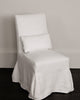
The Aubrey Dining Chair is Collection Seven's primary dining chair, and it is a piece of genuine elegance and practicality. Its defining feature is its flowing, floor-length linen cover — gently structured with deep corner pleats — which gives it a quality of considered refinement that sets it apart from almost all other upholstered dining chairs available in the UK market.
The floor-length cover is not merely decorative. It creates a visual continuity from the seat to the floor that gives the chair a settled, permanent quality — it reads as placed rather than perched. The soft back cushion provides genuine support across extended sitting. And the subtly curved arms and clean overall silhouette create a piece that is comfortable in the most complete sense — physically and visually.
The Aubrey is available in eight linen tones: ivory, chalk, cream, espresso, parchment, bamboo, butter and walnut. These span the range from the palest, most neutral options through warm mid-tones to deeper, more grounding shades. The linen palette makes the Aubrey naturally suited to the kinds of dining rooms where the furniture is expected to be both elegant and practical — the materials are beautiful but not fragile, and the floor-length cover can be carefully spot-cleaned as needed.
The Aubrey Carver Dining Chair
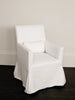
The Aubrey Carver Dining Chair is the armchair version of the Aubrey — sharing the same floor-length linen cover, deep corner pleats and soft back cushion, but with the addition of subtly curved arms. The carver is traditionally placed at the head of the table — one at each end — while standard chairs occupy the sides, creating a hierarchy within the arrangement that signals occasion and hosting.
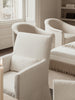
The practical case for including carvers in a dining arrangement is strong: they are more comfortable for the seats that tend to be occupied longest — the host and the guest of honour — and they create a visual punctuation at the ends of the table that gives the arrangement a sense of completion. Mixing the Aubrey Carver at the heads with Aubrey standard chairs along the sides is the most resolved configuration for a formal dining arrangement with the Collection Seven pieces.
Like the Aubrey, the Carver is available across the same eight linen tones. It is also available from £1,668 in its base configuration, which makes it accessible for the one or two positions in an arrangement that benefit most from the additional comfort and visual presence of a carver.
Mixing Chair Types at the Dining Table
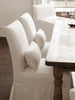
A dining table with matching chairs in a matching fabric creates a coherent, formal arrangement. But it is not the only approach, and in many domestic dining rooms it is not the most interesting one. Mixing chair types — carvers at the heads, standard chairs along the sides; or a bench on one side and chairs on the other — creates a less formal, more layered arrangement that can have more character and flexibility.
The combination of the Aubrey Dining Chair alongside the Aubrey Carver is the most natural mixing within the Collection Seven range — the two pieces share the same design vocabulary and fabric palette, so the combination reads as coherent rather than eclectic.
For a more deliberately contrasting arrangement — adding genuine material interest to the dining space — a bench along one side of the table alongside Aubrey chairs on the other creates a combination of seating types that is both practical and visually engaging. A Blenheim Bench in a boucle or velvet fabric alongside Aubrey chairs in a complementary linen creates a pairing of materials that gives the dining room genuine character.
Fabric Selection for Dining Chairs
Dining chairs face different practical demands from living room furniture. They are in proximity to food and drink; they are handled and moved more frequently; and they may be occupied by children as well as adults. The fabric choice should account for these factors.
Linen is the most practical choice for dining upholstery, and the Aubrey range's exclusive linen palette reflects this. Linen is strong, relatively spot-cleanable when spills are addressed promptly, and ages with character rather than simply wearing. Mid-tone linens — bamboo, parchment, ivory — are particularly practical because they manage everyday marks and variation more gracefully than the palest options.
For those who want a richer material note in the dining room and are prepared to give the chairs more active care, a velvet bench alongside linen chairs introduces material depth without compromising the practical durability of the primary seating.
The Dining Room as a Whole
Dining chairs are rarely chosen in isolation — they sit alongside a table, within a room that has its own architectural character, alongside other furniture and textiles. The most considered dining room arrangements are those where the chairs have been chosen with awareness of this wider context: relating to the table's material and finish, sitting within the room's overall palette, and contributing to the atmosphere of the dining space as a whole rather than simply providing seating.
In a dining room that also contains a sideboard, a rug, curtains and artwork, the chair fabric is one element of a palette that must work together. Assessing the chair fabric swatches alongside samples of the other materials in the room — the table finish, the rug, the wall colour — is the most reliable way to ensure the result is coherent. Order fabric swatches here and contact the team to discuss the right combination for your specific dining room.