collection seven, furniture guide, interior design
How to Choose the Right Armchair for Your Home
The Chair That Changes a Room
A well-chosen armchair does more for a room than provide a place to sit. It establishes character, creates a focal point, and — when placed in considered relationship with the other pieces in the space — produces the kind of arrangement that distinguishes a furnished room from one that has merely been equipped. The sofa provides the primary seating; the chair provides the personality.
This makes armchair selection one of the more rewarding decisions in the furnishing process — and one that benefits from a structured approach rather than an instinctive one. There are many ways to get it wrong: a chair that is too small reads as an afterthought; one that is too large competes with the sofa for dominance; one in the wrong fabric disrupts the palette of the room; one in the wrong silhouette creates a visual discord that is difficult to resolve without replacing the piece entirely.
Getting it right, conversely, transforms a room. Here is how to approach the decision properly.
Starting With Scale
The first and most practical question is one of proportion. An armchair must sit comfortably within the room without dominating it, and it must relate well to the sofa — close enough in scale to read as part of the same arrangement, distinct enough to function as a genuine counterpoint rather than a smaller copy of the main piece.
As a general guide, the back of the armchair should sit within 10–15cm of the sofa back height. A significant height difference — 20cm or more — creates a visual hierarchy that feels uncomfortable, as if the pieces belong to different schemes. Most of the Collection Seven lounge chairs are designed with back heights that sit in natural relationship with the sofa range, which simplifies this calculation considerably.
Consider also the physical footprint of the chair relative to the room. An armchair should not be placed in a position that obstructs natural movement through the space. It needs its own territory — a sense of being placed rather than inserted. Generally, leaving at least 60cm of clear passage around any furniture arrangement is the minimum; more in rooms where traffic between the sofa zone and other parts of the room is regular.
Understanding the Different Silhouettes
Each chair silhouette in the Collection Seven range communicates a different kind of presence and suits a different role within a room. Understanding these distinctions makes it much easier to match the right chair to the right context.
The Talbot Chair: An All-Round Favourite
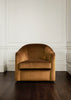
The Talbot Chair is described on the Collection Seven website as an all-round favourite, and it earns that designation. Its fixed, feather-filled seat cushion provides genuine comfort; the piped detail running around the curved arms and back gives it a quality of finish that is immediately apparent; and its combination of classic proportioning with contemporary restraint allows it to work across an unusually wide range of interior contexts.
The Talbot is available in one of the most extensive fabric ranges in the Collection Seven lounge chair category — spanning boucles, velvets, mohair velvets, linens, cloud linens, faux shearlings and patterns. This breadth of choice means it can be calibrated precisely to virtually any room palette. In fallow velvet with a bleached oak frame alongside an ivory boucle sofa, it creates a warm, considered arrangement that reads as designed. In oatmeal mohair velvet in a more minimal room, it becomes a quietly luxurious accent piece.
The Pembridge Chair: The Dedicated Snuggler
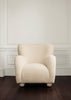
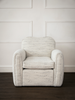
The Pembridge Chair is the most enveloping design in the Collection Seven chair range. Its curved back and arms wrap around the sitter in a way that makes it immediately comfortable — this is a chair that invites you to settle in for an extended period rather than sit formally upright. It is the definitive reading chair, the chair for a long afternoon with a good book, the chair you find yourself gravitating toward whenever the room offers a choice.
Its most distinctive quality is the relationship between its form and its available fabrics. In cream, natural or putty faux shearling — a deep, soft pile that adds another layer of physical warmth to an already enveloping form — it is one of the most immediately inviting pieces in the range. In boucle or mohair velvet, it takes on a different character but retains the same essential invitation.
The Pembridge is available with four wood stain options — bleached oak, white wash, walnut look and black — and the choice of frame stain significantly affects how the chair reads in the room. Black legs with cream faux shearling creates a contemporary, graphic contrast; bleached oak with oatmeal mohair velvet creates a warmer, more organic combination.
The Holland Chair: Character and Structure
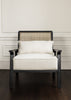
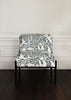
The Holland Chair has a distinctive identity within the Collection Seven range — its rattan back detail gives it a structural quality that the other chairs do not have. The frame, made from solid Ash, is more visually present than in most upholstered chairs, and the rattan creates a graphic quality that makes the Holland immediately recognisable.
This makes it particularly well suited to rooms with a more layered, eclectic sensibility — spaces where natural materials, pattern and character are more prominent than in strictly minimal schemes. The Holland Chair in autumn tapestry pattern, or in canvas cloud linen, works beautifully in a room that has some warmth and complexity to it. In a very minimal, restrained room, its structural character may be slightly too strong.
It features a fixed seat cushion and a removable, feather-filled back cushion — the latter adding a softness to what is otherwise a more structural piece. Available in an extensive fabric range including both patterns, it is one of the more characterful pieces in the collection.
The Colville Chair: Versatility and Proportion
The Colville Chair has a streamlined, contemporary quality that makes it one of the most versatile pieces in the range. Its clean, somewhat sleek design suits both modern and traditional rooms without belonging obviously to either. It reads as a sofa-appropriate companion piece — close enough in its language to sit comfortably alongside a range of sofa silhouettes — while having its own distinct character.
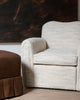
The Colville Chair has a companion ottoman — the Colville Ottoman — that shares its frame and fabric options and is designed specifically to work as a set. For rooms where a dedicated lounge chair arrangement is wanted — a reading corner, a window seat zone, a secondary seating area away from the main sofa — the Colville chair and ottoman together create a complete and self-sufficient arrangement.
The Addison Chair: Generous and Rounded
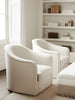
The Addison Chair has a rounded silhouette and a generous, spacious seat that makes it feel immediately welcoming. Its sloping armrests and gently curved backrest create a soft, inviting form that is comfortable for extended periods of sitting. In coconut or ivory boucle, it has a particular warmth — the rounded form and the textured fabric working together to create a piece that is both visually approachable and physically comfortable.
The Addison is available in an extensive fabric palette including boucles, velvets, mohair velvets, linens and cloud linens. Its generous form makes it well suited to being used as a statement piece — it has enough presence to anchor a corner of a room or serve as the centrepiece of a secondary seating arrangement without requiring the support of other significant pieces around it.
The Fabric Decision
An armchair covers a smaller area than a sofa, which means the fabric choice carries less financial risk and allows for slightly more adventurous choices. A chair is a good place to try a fabric you might not commit to across a whole sofa — a richer velvet, a pattern, a deeper tone.
In general, the chair fabric should be in tonal conversation with the sofa while being distinctly different in surface quality. A boucle sofa alongside a velvet chair; a linen sofa alongside a boucle chair; a mohair velvet sofa alongside a linen chair. These pairings create material contrast that gives the room depth without introducing colour conflict.
Always order fabric swatches and assess them in your room before ordering. Place the candidate swatch alongside the sofa fabric — either the actual sofa if it is already in place, or a swatch of the sofa fabric if you are choosing both simultaneously — and assess the relationship in your specific light conditions.
Placement and Relationship to the Sofa
The position of the chair within the room — its relationship to the sofa, the fireplace, the windows and the other elements of the arrangement — determines whether it functions as a genuine design element or simply as additional seating.
The most natural and most effective placement for a lounge chair in relation to a sofa is at a slight angle — not parallel and not perpendicular, but somewhere between the two. This angle creates a natural conversational orientation: the occupants of the sofa and the chair can see each other easily without having to turn their heads. It also gives the arrangement a dynamic quality — the slight offset of the chair prevents the arrangement from looking rigid.
A gap of 45–60cm between the side of the sofa and the near edge of the chair is generally appropriate — close enough to read as part of the same arrangement, far enough to allow movement between the pieces and to give each piece its own territory. If an ottoman is to be shared between the sofa and the chair, a slightly larger gap — 70–90cm — allows the ottoman to sit naturally between them without making either piece feel cramped. Explore the full lounge chair collection here and contact the team with any questions about specific room configurations.