collection seven, furniture guide, interior design
The Best Sofa for a Small Living Room in the UK
Small Rooms Deserve the Most Considered Furniture
There is a persistent misconception in interior design that small rooms require small furniture. This instinct is understandable but frequently wrong. What a small living room requires is not the smallest available option — it is furniture chosen with particular precision for that specific space. A well-proportioned sofa with the right silhouette, in the right fabric, can make a compact living room feel genuinely complete. The wrong sofa — regardless of its dimensions — will make it feel compromised.
In UK homes, this question is especially relevant. The terrace house sitting room, the open-plan studio apartment, the ground-floor flat with its necessarily modest floor plan: these are real rooms, and they deserve real furniture. The fact of their size is not a limitation to be managed but a design brief to be answered properly.
The First Principle: Silhouette Over Size
Before you consider the measurements of any specific sofa, think about its visual weight. Visual weight is distinct from physical size — it describes how much presence a piece occupies in a room. A sofa with heavy cushioning, thick rolled arms, a deep skirt and multiple scatter cushions will read as heavier and more space-consuming than a sofa of identical dimensions with a cleaner, more edited profile. In a small room, visual weight is often more important than actual dimensions.
The features that reduce visual weight in a sofa are: clean, straight or gently curved arms rather than rolled or heavily padded ones; visible legs rather than a skirted base that sits on the floor; a relatively low back height; and a fabric that reflects or diffuses light rather than absorbing it. These qualities together create a sofa that reads lightly in a room — that takes up less visual space even when its physical footprint is the same.
Raised Legs vs Skirted Bases
The presence or absence of visible legs is one of the most significant factors in how a sofa reads in a small room. When a sofa has visible legs — even modest ones — the floor is visible beneath it. This continuity of floor plane makes the room feel larger: the eye can travel under the sofa and across the floor, and the piece does not create a visual barrier at floor level. Skirted or floor-level sofas, by contrast, sit as solid blocks within the room, interrupting the floor plane and creating a more closed, heavy effect.
This is one reason why pieces with visible wooden frames tend to work well in smaller rooms. The structural honesty of a visible frame — legs, arm supports, stretchers — gives the eye something to read through, reducing the sense of mass.
Which Sofas Work Best in Small UK Living Rooms
With these principles established, it becomes possible to assess specific silhouettes in practical terms.
The Clarendon Sofa
The Clarendon Sofa is one of the most versatile pieces in the Collection Seven range for exactly this context. Its defining feature is a continuous arm and back design — the line flows uninterrupted from one arm, around the back, and down to the other arm. This creates a clean, architectural silhouette with no visual clutter. The singular seat cushion and lumbar back cushion maintain this clarity; there are no multiple scatter cushions or layered elements to add bulk.
In a two-seater configuration, the Clarendon is compact enough to suit most smaller UK living rooms while retaining the quality and presence of a properly considered piece. In chalk linen or ivory boucle it reads as light and open; in a deeper tone like bamboo linen or sepia velvet it can create a more intimate, deliberately enclosed atmosphere — useful in rooms where the goal is to create warmth rather than openness.
The Courtnell Sofa
The Courtnell Sofa takes a similarly restrained approach. Defined by its simplicity and refined proportions, it features a single generously scaled seat cushion that creates an uninterrupted horizontal line — one of the cleanest profiles in the collection. Its back cushion arrangement is equally edited, and the result is a piece that manages to feel generous and comfortable without claiming more visual space than it needs.
In a two-seater configuration and in a pale linen — chalk, cream, parchment or macadamia cloud linen — the Courtnell is particularly well suited to rooms where keeping the space feeling open and light is the priority. It sits quietly in a room rather than demanding attention, which in a small space is exactly the quality you want from the largest piece of furniture.
The Albion Sofa
The Albion Sofa brings a slightly more relaxed, traditionally-inspired approach to the same discipline of restraint. Its gently curved arms and soft finish give it an easy, settled quality that works well in compact rooms where the priority is comfort and ease over architectural precision. Its relatively modest arm profile keeps the visual weight controlled, and its availability across a wide range of linens makes it adaptable to rooms with varying amounts of natural light.
The Case for a Two-Seater Plus a Chair
In many small UK living rooms, the most effective seating arrangement is not a single sofa but a two-seater sofa alongside a compact lounge chair. This combination provides equivalent or greater seating capacity than a three-seater sofa — four people can sit comfortably in a two-plus-one arrangement where four would be genuinely cramped on a three-seater — while creating a much more flexible and visually interesting arrangement.
The chair can be positioned at a slight angle to the sofa, creating a natural conversational arrangement. It introduces a second silhouette and potentially a second fabric into the room, adding richness and personality that a single sofa cannot provide. And it allows the room to be rearranged more easily than a large fixed sofa permits.
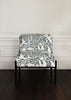
The Colville Chair, with its streamlined design and relatively compact footprint, works particularly well in this role. The Pembridge Chair, with its curved, enveloping form, creates a stronger accent within the arrangement but still reads lightly thanks to its visible wooden frame detail. Either chair, placed alongside a two-seater Clarendon or Courtnell sofa, creates an arrangement that feels complete and considered without overwhelming a modest floor plan.
Getting the Fabric Right for a Small Room
In a small living room, the sofa fabric occupies a proportionally larger area of the visual field than it would in a larger space. This makes the fabric choice both more consequential and more visible. A few specific principles apply.
Lighter Fabrics Open the Space
Lighter fabrics — chalk linen, ivory boucle, cream linen, canvas cloud linen, macadamia cloud linen — make a small room feel more spacious. They reflect and diffuse light, keeping the room bright and open. They also tend to feel less heavy visually, which reinforces the sense of space even when the physical dimensions are unchanged.
This does not mean darker fabrics are impossible in a small room. A sofa in bamboo linen or sepia velvet can work beautifully in a compact space — but it requires the rest of the room to be managed carefully. The walls, flooring and other textiles need to give the sofa space to read rather than compressing around it.
Texture Adds Interest Without Adding Colour
In a small room where a pale, neutral fabric is the practical choice, texture becomes the primary vehicle for material interest. Boucle — with its looped, textured surface — introduces visual and tactile richness without the colour commitment or light-absorbing quality of velvet. A sofa in ivory or ecru boucle reads as neutral and light while still having genuine material character. This is why boucle has become such a consistently popular choice for compact living rooms — it resolves the tension between practical restraint and aesthetic ambition.
What to Avoid in a Small Living Room
Just as important as knowing what works is understanding what tends not to. In a compact living room, avoid sofas with very heavily cushioned backs that add significant depth without adding comfort. Avoid dark, saturated fabrics unless the rest of the room is specifically designed to accommodate them. Avoid placing the sofa on a rug that is too small — the rug should sit beneath the front legs of all pieces in the arrangement at minimum, and preferably beneath all four legs. A rug that is too small fragments the room further rather than defining the zone.
Avoid the instinct to fill every available surface with furniture. In a small room, restraint is more effective than abundance. Three pieces chosen carefully will always work better than five chosen acceptably.
The Made-to-Order Advantage
For rooms with unusual dimensions — an alcove of a specific width, a room where a standard two-seater is slightly too narrow but a three-seater clearly too wide — the made-to-order model is perhaps most valuable. Rather than accepting a compromise, you can specify the width that fits your room precisely. Collection Seven makes every piece to order in London, and conversations about sizing — including non-standard dimensions — are a routine part of the process.
Contact the team to discuss the specific dimensions of your room. Bringing a floor plan, even a rough sketch, will make the conversation more productive and ensure the piece you receive is genuinely right for the space. For a small room, getting the size exactly right is not a luxury — it is the difference between a room that works and one that does not.
Browse the full sofa collection and consider ordering fabric swatches to assess the materials in your specific light conditions before making a final decision.