collection seven, furniture guide, interior design
Bespoke vs Ready-Made Furniture: What's the Real Difference?
The Word Bespoke Has Been Stretched Almost Beyond Recognition
In the furniture industry, the word bespoke is applied to a remarkable range of products — from genuinely commissioned, one-off pieces made entirely to a client's specification, to mass-produced sofas that simply come in three colourways. Understanding what bespoke — and its close relative, made to order — actually means in practice is the necessary foundation for making an informed decision about which type of furniture to buy.
The distinction matters not just philosophically but practically. The type of furniture you choose determines what is possible in your home — the dimensions you can achieve, the materials you can specify, the degree to which the piece belongs to your space rather than simply being placed within it. This guide sets out to clarify the genuine differences between bespoke, made-to-order and ready-made furniture, and to help you determine which approach best suits your circumstances.
What Ready-Made Furniture Is
Ready-made furniture — sometimes called off-the-shelf or in-stock furniture — is designed and manufactured in advance, typically in large volumes, and sold from existing stock. The sizes, fabrics, configurations and finishes are all predetermined. When you buy a ready-made sofa, you are choosing from a set of existing objects rather than specifying something to be made.
The advantages of this model are real: the lead time is short (often days or weeks rather than months), the price reflects the economies of production at scale, and there is no uncertainty about what you will receive — you can see the exact piece, in the exact fabric, before you commit. For certain furniture categories — side tables, storage, occasional accessories — ready-made is frequently the sensible choice.
But for the furniture that anchors a room — the primary sofa, the key lounge chair, the bed — ready-made imposes constraints that are worth understanding. The dimensions are fixed. The fabrics are determined by what the manufacturer has decided is commercially viable. The design is created to appeal to the widest possible audience, which means it tends toward the generalised rather than the particular. And the quality of construction reflects the economics of mass production, which prioritises efficiency over craftsmanship.
None of this is a moral failing. It simply means that ready-made furniture, chosen well, can furnish a room acceptably. But it rarely furnishes a room perfectly — because perfect furniture for a specific room requires knowledge of that specific room, and a manufacturing process responsive to it.
What Made to Order Actually Means
Made to order sits between fully bespoke and entirely ready-made. A made-to-order piece is manufactured to your specification within a defined framework: an established range of silhouettes and sizes, a curated fabric palette, a set of finish options. You choose from these parameters; the piece is then built specifically for you. It does not exist in a warehouse before your order. It is made because you ordered it.
This model has several significant implications. Because each piece is built from the beginning, dimensions can typically be adjusted within a practical range — a sofa can be made slightly narrower or wider to suit a particular alcove; a bench can be specified to fit between two walls precisely; a bed can be made in a non-standard size. The fabric is chosen from a full palette rather than from whatever happens to be in stock. And the construction is typically more considered than mass production allows, because the economics of made-to-order work are different from those of volume manufacturing.
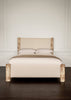
This is precisely the model that Collection Seven operates. Every piece — from the Clarendon Sofa to the Artesian Bed — is made to order in London. There is no stock. The piece is built when you commission it, by craftspeople working in the Collection Seven workshop, using materials chosen for their quality rather than their cost. The lead time is longer than buying from stock — but what you receive is a piece made for you, in your fabric, to your dimensions.
What Fully Bespoke Furniture Is
Fully bespoke furniture goes beyond made-to-order in that it is designed, as well as made, specifically for the client. There is no predefined silhouette to work from — the design itself emerges from the conversation between client and maker. This is the most expensive, most time-consuming and most particular approach, and it is most appropriate for situations where no existing design serves the brief — a built-in piece for an unusual architectural space, a one-off commission for a specific room, a piece that needs to serve functions that standard designs do not accommodate.
For most domestic furniture requirements, made-to-order represents the appropriate point on this spectrum: it provides the customisation that matters most (dimensions, materials, finishes) within a framework of proven, well-considered design. Full bespoke adds cost and time without, in most cases, adding meaningful value beyond what made-to-order already delivers.
The Practical Differences in Daily Life
It is worth being specific about what the differences between ready-made and made-to-order mean in practice — not in abstract terms but in the daily experience of living with the furniture.
Dimensions
A ready-made sofa comes in fixed sizes. If your room suits a 185cm-wide sofa and the manufacturer offers a 175cm two-seater and a 205cm three-seater, you have two choices: accept the gap (which will read as a visual awkwardness), fill the space with additional pieces, or compromise. With a made-to-order piece, the width can be specified to fit correctly. This is not a small thing. Furniture that fits a room precisely creates a sense of rightness that subtly shapes how the room feels to be in — it is one of those qualities that is difficult to articulate but immediately apparent when it is absent.
Materials
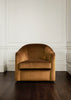
Ready-made furniture is available in the materials the manufacturer has chosen to stock. If none of those materials is quite right for your room — the wrong tone, the wrong texture, not quite the right relationship with your existing palette — there is nothing to be done about it. With made-to-order furniture and a well-curated fabric palette, the material choice is genuinely yours. The Talbot Chair, for instance, is available across dozens of fabric options — velvets, mohair velvets, linens, cloud linens, boucles, faux shearlings and patterns. The chair you receive is not the chair from the catalogue with an acceptable fabric substitution; it is the specific chair, in the specific material, that belongs in your room.
Construction Quality
Made-to-order furniture built by skilled craftspeople tends to use construction methods that volume production cannot accommodate. A hardwood frame properly jointed with traditional techniques; hand-tied spring systems that distribute weight correctly; upholstery work executed with precision and care. These are not merely aesthetic qualities — they directly determine how the piece performs over years and decades of use. A well-constructed sofa will maintain its form and comfort for twenty or thirty years. A poorly constructed one will show its limits within five.
The Trade Programme
For interior designers and architects working on client projects, the Collection Seven trade programme extends the made-to-order offer further. Bespoke sizing, customer's own material (COM — the client's or designer's chosen fabric applied to the Collection Seven construction), and accommodations for larger or more complex orders are all possible within the trade framework. This is the model that most closely approximates full bespoke while retaining the efficiency and design integrity of working within an established range.
When Ready-Made Is the Right Choice
It would be misleading to suggest that ready-made furniture is always the inferior option. For rooms with genuinely standard dimensions, standard requirements, and a short timeframe — a rental property, a room that needs furnishing quickly, or a space where furniture is genuinely temporary — ready-made can serve perfectly well. The key is to be honest about which category your situation falls into, rather than defaulting to one model without considering the other.
For the rooms that matter most — the rooms you spend the most time in, the rooms that define the character of your home, the rooms you are furnishing for the long term — made-to-order is almost always the more intelligent investment. The additional time and cost, assessed against a piece that will be used daily for twenty years, resolves into a very reasonable proposition.
Beginning the Process
The made-to-order process begins with understanding what you need. Browse the full Collection Seven range to identify the silhouettes that appeal and suit your context. Order fabric swatches to assess the materials in your room. And contact the team with specific questions about dimensions, configurations or anything else that requires direct conversation. The process of ordering a made-to-order piece should feel collaborative and straightforward — if it feels complicated or opaque, that itself is a signal about the maker you are working with.